Routine Care |
Soothing
Baby Soothing Techniques
This article describes the following items about soothing techniques:
Meet Needs
In order to soothe your baby, the most important thing is to first determine what she needs by listening to your baby's cry. Before I had my son, one day I was watching Oprah and she had on Priscilla Dunstan who believes you can understand a baby’s cry and she feels cries can be divided into five different types:
- NEH – Hunger (due to sucking reflex)
- OWH – Sleepy (like baby is yawning)
- HEH – Discomfort (diaper needs changed or hot/ cold)
- EAIR – Lower gas (may pull up legs as well)
- EH – Baby needs to burp
Dunstan said the cry sounds are "actually sound reflexes" that will generally turn off after the first 3 months unless the cries are appropriately responded to. The baby may continue to make the sounds if it gets the response it wanted. The other important thing to note according to Dunstan is these sounds are more the "pre-cry" the beginning sounds the baby makes. If the baby is not attended to, then this "pre-cry" will turn into a full cry and the sounds will be harder to distinguish.
I believed this woman but I wasn’t sure I would be able to distinguish the difference with my baby. Once I had my baby, my husband and I were able to confirm that most of the time we could tell the difference. The NEH and the OWH were probably the most distinguishable cries. For more information on this Oprah episode, please refer to this link within the Oprah.com web site.
Please refer to this link to refer directly to Dunstan's web site.
Another way to determine what your baby needs is to follow the E.A.S.Y. (Eat, Activity, Sleep, You) schedule promoted by Hogg. If you follow this schedule or a schedule that works well for your baby then it will be easier to predict what your baby needs. Please refer to the "Secrets" article for more information about the E.A.S.Y. schedule and also other tips Hogg provides in her book, Secrets of the Baby Whisperer.
In addition, it may help to document your baby's schedule such as when your baby last ate, had her diaper changed, and slept. Even if you don't plan to follow a schedule, documenting when your baby last did things will help you predict what she needs next. You may find that your baby puts herself on a schedule whether you plan for it or not. Please refer to the "Schedule Versus Demand" article for more information. Refer to this template to document a schedule for a baby 0-6 months and this template for a baby 6+ months.
I think it is important to remember what Hogg lists as a few things I believe will not only help you bond with your baby but also meet her needs:
Are respectful of your baby
Know your baby as a unique individual
Talk with, not at, your baby
Listen and, when asked, meet your baby’s needs
Let your baby know what’s coming next by providing a daily dose of dependability, structure, and predictability (11)
(To Top)
Parent or Self Soothe?
When the baby is first born, you will have to do parent soothing methods. As the baby gets older he will start to be able to self-soothe and he shouldn't require as much parent soothing. We did a combination of parent-soothing and "self-soothing." Whether to do parent soothing or allow the baby to self sooth is debated especially when it comes to nighttime parenting to teach the baby to fall asleep.
In the parent-soothing method, “a parent or other caregiver helps baby make a comfortable transition from being awake to falling asleep, usually by nursing, rocking, singing, or whatever comfortable techniques work.” The benefit would be that this “builds parent-infant trust....” but the disadvantage is that “baby learns to rely on an outside prop to get to sleep…” (Sears, "31 Ways").
The self-soothing method is when the baby “is put down awake and goes to sleep by himself. Parents offer intermittent comforting, but are not there when baby drifts to sleep.” The advantage would be “baby learns to go to sleep by himself, he may be better able to put himself back to sleep without parental help….” The disadvantage would be this may require the parent to do the cry it out approach (Sears, "31 Ways"). In general, if you do decide to do the cry it out approach, I believe most research recommends you at least avoid it for the first six months.
I was fortunate and we never had to use the cry it out approach with our son and our son was able to learn to self soothe and put himself to sleep. Now, this doesn’t mean that my baby NEVER cried in his crib, although when he did we tried to follow the sensible sleep ideas discussed in the "Nighttime Parenting" article. Early on we would lay my son in his crib before he was in a deep sleep and let him drift off on his own. If he ever showed discomfort then we would pick him up and rock him longer. Please refer to our family's approach for more information as to techniques that worked well for my family. In addition, please refer to the "Sleep Tips" article.
(To Top)
Swaddle
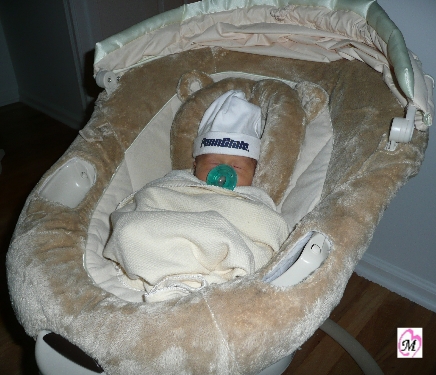
The first couple months the best thing to soothe my baby was to swaddle him. We primarily swaddled him only at nap time or bedtime. It was amazing to watch him immediately become calm and content as we started to swaddle him. Any blanket can be used to swaddle a baby. We asked the nurses at the hospital and they showed us how to swaddle our baby with a standard receiving blanket. Once you learn how to do it, it is very simple.
Many families have discovered their favorite swaddling blanket and many people were kind and sent us their favorite swaddling blanket. As our baby got older and stronger, we preferred the miracle blanket to swaddle our son for nap and nighttime sleep. The miracle blanket is more expensive than most of the other swaddling blankets but we felt it was well worth the extra cost. We found the miracle blankets at BuyBuy Baby and you can also buy the blankets through the miracleblanket.com web site.
Some other brands of swaddling blankets are:
The Sozo swaddle blankets are decorative type swaddling blankets and would probably make some really cute pictures. Depending on what swaddling blanket you have, I would recommend at least two; that way if one is dirty at least you have one spare. The "Swaddling" article is coming soon.
(To Top)
Soothing Sounds
You will probably find a sound that will help calm your baby. Whether it is you talking or singing to your baby, the sound of the vacuum cleaner, static on the radio, heartbeat or womb sounds or a traditional lullaby. Also, saying, "Shhh" fairly loud, not a soft "Shhh" but as loud as you can do it really calmed our baby. At first my mom was confused as to why I was saying "Shhh" so loudly to our baby rather than whispering it but it seemed I needed to meet the level of our son's cry, if he was crying loudly then I needed to make the "Shhh" sound loudly and generally it would calm him down.
My son loved when I would sing to him even though I am completely tune deaf. My son is probably the only person in the world that would want to hear me sing. I would sing whatever popped in my head and it usually dealt with whatever we were doing. My son also loved hearing any music. Before bedtime or nap time we would generally play lullabies or baby classical music. If my son was really upset we may play heartbeat sounds, womb sounds, ocean waves, or other similar sounds and they usually worked to calm him fairly quickly. Also, if it wasn't time for nap time and my son started to get upset I would play upbeat music and hold him and dance around the room and generally it immediately made him happy again. I'm sure you'll find the sound that works best for you and your baby. My two year old still loves music. His favorite bedtime lullaby now is "Twinkle, Twinkle, Little Star" and he'll start singing it before bed and requests us to join in.
(To Top)
Pacifier
A lot of babies have an increased sucking need beyond sucking for nutritional purposes. According to the American Academy of Family Physicians (AAFP), the “benefits of pacifier use include analgesic effects, shorter hospital stays for preterm infants, and a reduction in the risk of sudden infant death syndrome." Thus, it is recommended to give pacifiers to "newborns and infants undergoing common minor procedures in the emergency department (e.g., heel sticks, immunizations, venipuncture)" to help relieve pain. In addition, "the American Academy of Pediatrics recommends that parents consider offering pacifiers to infants one month and older at the onset of sleep to reduce the risk of sudden infant death syndrome” (AAFP).
My son loved his pacifier from day one. We used it primarily for naps and bed time but did initially use it during the day to calm him if we knew he wasn’t hungry. We also used it at feeding time when it was time to burp him. Please refer to "Feeding Tricks" as to why we found the need to use a pacifier when we burped my son.
Some potential adverse effects could include a "negative effect on breastfeeding" dental problems, or ear infections (AAFP). Some recommend not introducing a pacifier use until breastfeeding has been well established. "Adverse dental effects can be evident after two years of age, but mainly after four years" and the "American Academy of Pediatrics and the American Academy of Family Physicians recommend weaning children from pacifiers in the second six months of life to prevent otis media [ear infections]" (AAFP).
My son still had a strong sucking need at six months and since he did not suffer from ear infections we didn't wean at that time. I also read that the use of a pacifier may help babies with acid reflux so I didn'’t mind letting my son use his pacifier. (My son was on medication for reflux until he was two+ years old.) At two years old my son still does use his pacifier primarily only at nap and bedtime. Since he was a baby we tried to only give him his pacifier at nap and bedtime so he didn't have it in his mouth all day.
I took my son to his first pediatric dentist appointment when he was 18 months old and I discussed with the dentist if I needed to wean my son from his pacifier. Our dentist said the earlier you can wean the better, but you really just need to make sure you wean him by four years old to avoid permanent dental damage. She said if you try to wean and he starts sucking his thumb she prefers to give him back his pacifier as based on her experience it is easier to eventually break from pacifier use than from sucking a thumb. After that conversation, I noticed that there were a few instances where my son did start to suck his thumb when he was tired and wanted his pacifier and so I definitely felt my son still wasn't ready to be weaned. I plan to make sure my son is weaned by around three years old. (My son has a baby sister coming when he is around 2 1/2 years old so I'm giving some extra time to allow for that transition.)
A minor problems with letting babies sleep with a pacifier when they are little is that when it falls out of their mouth they may wake up. We went through a period where some nights we were going into the bedroom to put the pacifier back in. My son did eventually learn how to find his pacifier in the middle of the night and put it back in and or he learned to sleep without it. Overall, "[p]acifier use should not be actively discouraged and may be especially beneficial in the first six months of life" (AAFP).
Some people prefer their baby to suck on his/her thumbs and/or to obtain additional sucking by using Mommy's breasts as a pacifier. My daughter wanted nothing to do with a pacifer and at 4 months still will not use one. I guess at least I won't have to worry about breaking her from a pacifier. The "Pacifier" article is coming soon.
(To Top)
Different Holds
Babies like to be held different ways as well. My baby preferred to be held differently for Mommy than he did for Daddy. It may have simply been that both of us felt more comfortable with a certain hold and ultimately that made our baby feel more comfortable. My favorite hold was laying my baby on my shoulder and I enjoyed resting my chin on the top of his head. My husband liked to do the hold where the baby lies on his side facing away from you, this hold is sometimes referred to as the football hold.
(To Top)
Motion
Most babies are calmed by some form of motion whether it is rocking, baby wearing, a baby swing, walking, riding in the stroller, or going for a car ride. As an infant my son initially preferred rocking to calm him before nap and bedtime. Later, when my son was around six months old and started to protest naps we had to walk him to sleep (carrying him while walking around the room) sometimes at a very brisk pace. I would practically run circles in his room and after a few circles he would calm down, once he was calm I would then sit and rock him for awhile.
I wore my baby every day for the first few months. My baby loved being carried in the BabyBjorn. I would think most babies would like some sort of baby wearing, especially in the early months as they are use to being “bounced” around in your belly and now they can be calmed by your smell, touch, and movement. Baby wearing may help reduce crying as it reminds the baby of the womb which thus “lessens baby’s anxiety and lessens the need to fuss” (Sears 304). For more information, please refer to the "Baby Wearing" article.
Another form of motion a lot of babies like is a baby swing. We only used our baby swing occasionally for the first couple months, usually during the day, or in the middle of the night if we couldn’t get my baby back to sleep in his crib. It was the one purchase, I don’t think we got our money’s worth but on the other hand that meant my baby didn’t need it. For some babies I think the baby swing is a life saver. Some babies initially sleep best in a baby swing and may only take naps in their baby swing. We did use the swing the night my baby was extremely upset due to an ear infection as he was better able to sleep in the swing since it kept him more upright than in his crib.
Some babies fall asleep easiest in the car. My friend would put her baby in the car seat, drive around and then simply put the baby while still in the car seat directly in her crib. Her doctor said it was ok to temporarily let the baby sleep in the car set while in the crib and he said it will allow her baby to get use to the crib surroundings. I would check with your healthcare professional as to different ways you can safely let your baby sleep.
(To Top)
Other Techniques
Some other techniques you may want to try to calm your baby would be to give your baby a warm bath and a massage, especially before bed. We started the routine of giving our baby a bath before bed and it really helped him get in a routine and understand when it was time for nighttime sleep. Our baby never really liked getting a massage but I know a lot of babies that do.
When our son seemed to be upset due to gas or constipation, patting his bum very fast and fairly hard, at least 60 times in a minute seemed to calm him.
(To Top)
Resources
Some of the tips described above I found through some of my favorite parenting resources and I then modified the techniques to best meet my baby's needs. Please refer below for some of those resources.
Parenting Books:
- The Baby Book: Everything You Need to Know About Your Baby - From Birth to Age Two by William Sears, M.D., and Martha Sears, R.N. with Robert Sears, M.D., and James Sears, M.D. I enjoy reading information written by the Sears family since they offer real-life practical advice with the added benefit of being written by medical professionals.
- Secrets of the Baby Whisperer: How to Calm, Connect, and Communicate with Your Baby by Tracy Hogg with Melinda Blau. I enjoyed reading this book as it went along with my parenting philosophy to truly listen to my baby.
- What to Expect the First Year by Heidi Murkoff, Arlene Eisenberg, and Sandee Hathaway, B.S.N. This provides similar information to The Baby Book: Everything You Need to Know About Your Baby - From Birth to Age Two.
Parenting Web sites:
- American Academy of Family Physicians (“AAFP”) - http://www.aafp.org/online/en/home.html
- American Academy of Pediatrics
- Dr. Alan Greene – as stated on the “About Dr. Greene” has “devoted himself to freely giving real answers to parents’ real questions….” His web site and books promote “green” living. Please refer to his site - http://www.drgreene.com
- The Sears Family Web site written by William Sears, M.D.,Martha Sears, R.N., James Sears, M.D. and Robert Sears, M.D. - http://askdrsears.com. I enjoy reading information written by the Sears family since they offer practical advice with the added benefit of being written by medical professionals.
Please refer to the "Parenting Resources" article for a full list of resources.
(To Top)
End Note
You will find that soothing techniques will evolve as your baby grows. The most important thing is to listen to your baby and do your best to try to meet your baby's needs.
Also remember that the baby's crying is not your fault. Crying is a baby’s way of communicating but it doesn’t mean you are doing a bad job. It is simply the only way the baby can try to tell you something. I really like the following quote from Sears “…it is not your fault that your baby cries, nor is it your job to keep baby from crying. The best you can do is not to let baby cry alone, and create a secure environment that lessens baby’s need to cry” (The Baby Book, 304).
You should start to be able to interrupt your baby’s cries, as described above. If you feel you are having trouble interpreting your baby's cries you could also try to use the E.A.S.Y schedule as discussed in the "Secrets of the Baby Whisperer" article to help you determine what your baby needs. To eat? To sleep? In the end you will never be able to completely stop your baby from crying. In addition, if you do have a baby that is colicky, there may only be so much you can do to help the baby to relieve the crying. Please refer to the "Colic" article for more information.
Please remember if you need to take a moment and gain your composure, it is better to lay your baby down in a safe place, such as the crib, and if the baby cries, she cries. You can go back and help her once you have settled yourself down. I hope some of the things above which helped soothe my baby can help soothe your baby as well.
(To Top)
Works Cited
American Academy of Family Physicians (AAFP). "Risks and Benefits of Pacifiers." American Family
Physician. 15 April 2009: 681-685. 26 Aug 2010 <http://www.aafp.org/afp/2009/0415/p681.html>.
Hogg, Tracy and Melinda Blau. Secrets of the Baby Whisperer: How to Calm, Connect, and
Communicate with Your Baby. New York: Ballantine, 2001.
Oprah. "Amazing Medical Breakthroughs." OPRAH.COM. 7 Jan. 2010
<http://www.oprah.com/slideshow/oprahshow/oprahshow1_ss_20061113>.
Sears, William M.D., Martha Sears, R.N., James Sears, M.D., and Robert Sears, M.D. "31 Ways to Get
Your Baby to Go to Sleep and Stay Asleep Easier." AskDrSears.com. 26 Jan 2010
<http://www.askdrsears.com/html/7/T070300.asp>.
Sears, William M.D., Martha Sears, R.N., Robert Sears, M.D. and James Sears, M.D. The Baby Book:
Everything You Need to Know About Your Baby - From Birth to Age Two. New York: Little, 2003.
(To Top)
Last updated: August 2010; March 2011